
How Much Does Crawl Space Encapsulation & Vapor Barrier Cost in Cupertino?
Crawl Space Encapsulation & Vapor Barrier services in Cupertino, CA typically run between $3,800 and $9,500 for a standard single-family home, with most jobs in the 1,200-to-2,000 square foot crawl space range landing around $5,500 to $7,200. Vapor barrier-only installations (liner without full encapsulation) start closer to $1,800 to $3,200 depending on liner thickness and access conditions. Given Cupertino’s aging housing stock – many homes here were built between 1955 and 1985 with original vented crawl spaces – full encapsulation is more common than in newer developments because the moisture infiltration problems are already visible by the time a homeowner calls us.
Crawl Space Encapsulation & Vapor Barrier Cost Breakdown (2026)
Most homeowners in Cupertino want to know what they’re paying for before a technician arrives. Here’s how the cost breaks down across the services that typically make up a crawl space encapsulation project:
| Service Component | Typical Cost Range (Cupertino, 2026) | Notes |
|---|---|---|
| 20-mil reinforced vapor barrier (liner only) | $1,800 - $3,200 | Covers ground, lapped up walls 6-12 inches, seams taped |
| Full encapsulation (liner + wall coverage + sealed vents) | $4,500 - $7,800 | Most common full-scope job in Cupertino’s 1,400-1,900 sq ft crawls |
| Crawl space vent sealing | $300 - $700 | Closing foundation vents is part of conditioned-crawl conversion |
| Drainage matting / dimple board | $400 - $900 | Added when standing water or seasonal intrusion is present |
| Insulation removal (old fiberglass batts) | $600 - $1,400 | Common in pre-1990 Cupertino homes; required before liner install |
| Spray foam rim joist sealing | $500 - $1,200 | Closes the gap between foundation wall and floor framing |
| Dehumidifier (installed, crawl-rated) | $1,200 - $2,400 | Recommended when relative humidity exceeds 60% consistently |
| Mold remediation prep (surface treatment) | $400 - $1,100 | Applied to floor joists before liner; does not replace licensed mold remediation |
| Sump pump installation | $900 - $2,200 | Needed on lots with documented groundwater history |
A typical full Crawl Space Insulation project in Cupertino – sealing vents, installing a 20-mil liner across the ground and partway up the walls, spraying the rim joist, and removing deteriorated fiberglass batts from the subfloor – runs $5,800 to $8,500 all in. That range reflects actual labor and material costs in the South Bay market as of 2026, including the 10 to 15 percent premium that Santa Clara County contractors consistently carry over inland California markets due to labor rates and disposal fees.
Projects push toward $9,500 or higher when the crawl has standing water, severe pest damage requiring subfloor repairs, or access points smaller than 18 by 24 inches (the IRC minimum, which some older Cupertino homes do not meet, requiring temporary panel removal or new access cut-ins). Jobs stay closer to the lower end when the crawl is dry, clear of debris, and accessible through a full-size door or large hatch.
Under Haven Standard Clause 1, every project at Envelope Insulation Co. starts with a written price before any work begins. The flat-rate scope we hand you describes exactly which components are included – liner thickness, vent count, rim joist linear footage – so you’re comparing apples to apples when you review other quotes.
What Affects Crawl Space Encapsulation & Vapor Barrier Pricing in Cupertino
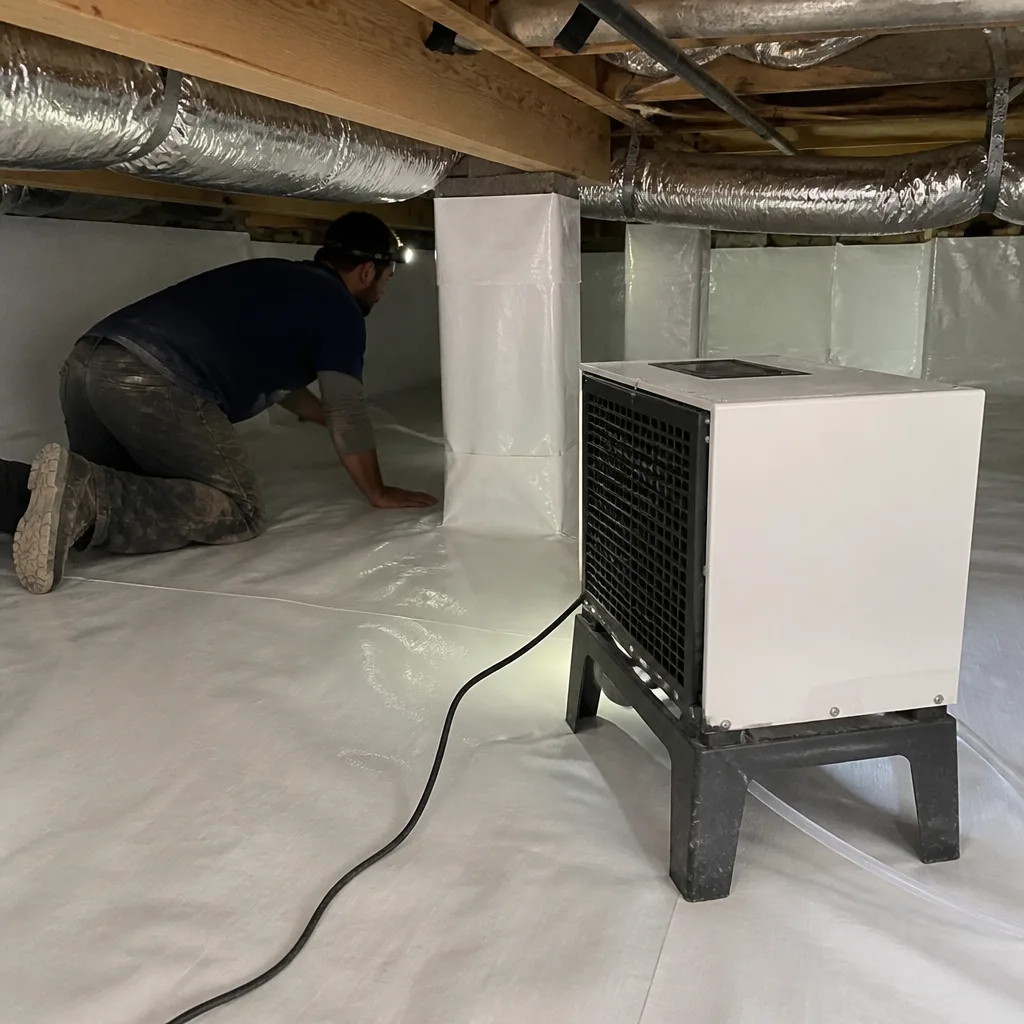
Six factors move the number more than anything else in the Cupertino market specifically:
- Crawl space square footage and height. Most Cupertino homes built before 1975 have crawl heights between 18 and 36 inches. A low clearance space – under 24 inches – adds labor time and limits what equipment can be used, pushing the per-square-foot cost up by $0.40 to $0.80. A full-standing crawl at 48 inches or more is faster and slightly cheaper per square foot.
- Liner thickness and material grade. A basic 6-mil poly sheeting costs less upfront but doesn’t hold up against foot traffic during maintenance visits or rodent pressure, which is real in Cupertino neighborhoods adjacent to the Rancho San Antonio open space. A 20-mil reinforced liner costs roughly $0.30 to $0.50 more per square foot but resists puncture and lasts significantly longer. We use 20-mil as our standard, not as an upsell.
- Existing moisture and mold conditions. Cupertino sits at roughly 200 feet elevation with clay-heavy soils in some neighborhoods – Monta Vista, Homestead, and parts of the Garden Gate area see seasonal moisture intrusion that flat-surface neighborhoods don’t. If there’s active moisture wicking through the slab or walls, drainage matting and a dehumidifier go on the scope, adding $1,500 to $3,000 to the base job.
- Old insulation removal. Most Cupertino homes built in the 1960s and 1970s have fiberglass batt insulation stapled between the floor joists. That material needs to come out before a liner goes in – both because it traps moisture and because encapsulation of the wall and rim joist changes the thermal boundary of the home. Removal costs $600 to $1,400 depending on volume and contamination level.
- Vent configuration and sealing complexity. A standard Cupertino ranch home has 6 to 12 foundation vents. Each one gets sealed as part of a conditioned-crawl conversion. Simple block-and-seal jobs run $50 to $75 per vent. Vents with damaged frames or corroded screens that need to be cut out and reframed run $90 to $150 each. An older home with 14 vents adds up fast.
- Access and site conditions. Narrow side-yard access on a zero-lot-line Cupertino lot means materials have to be hand-carried rather than wheeled in. Homes with concrete perimeter walls and no crawl door require cutting a new access opening (typically $400 to $700 for a code-compliant hatch). Both add labor cost that doesn’t show up on a per-square-foot quote.
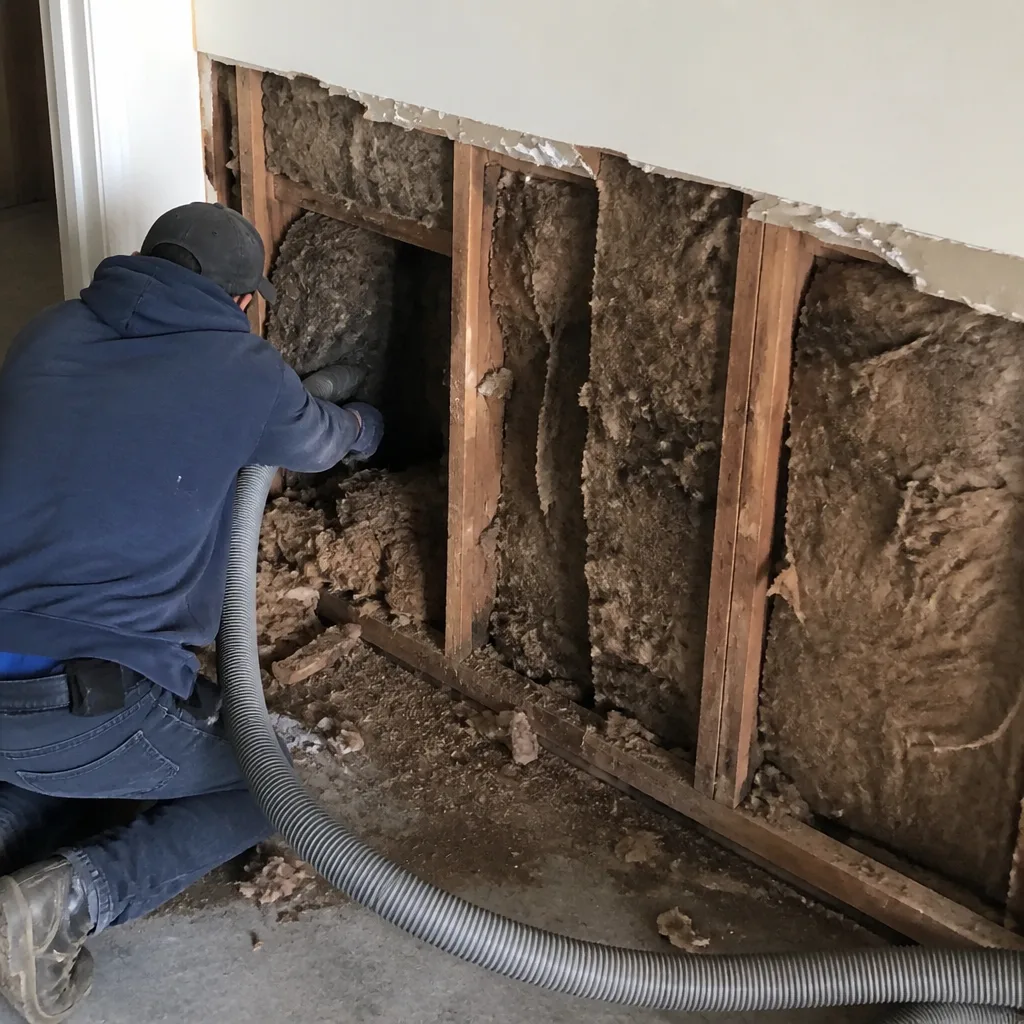 Before
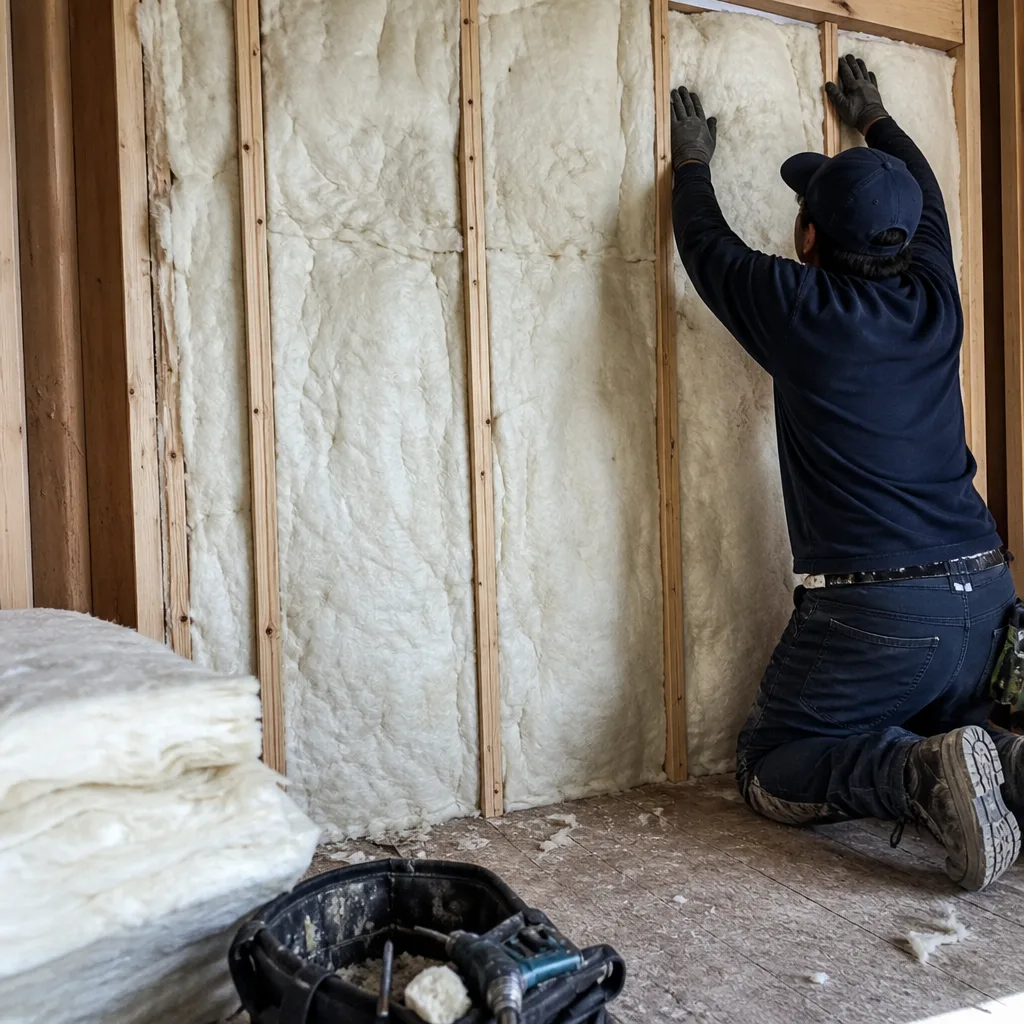 After
AfterCupertino-Specific Factors You Won’t Find in Generic Pricing Guides
Generic cost articles quote national averages that don’t reflect what you’ll actually pay for crawl space work in the South Bay. A few things are specific to Cupertino that shift the numbers:
Clay soil and winter moisture. Parts of west Cupertino near Foothill Boulevard and the lower Monta Vista foothills sit on expansive clay that holds moisture well into late spring. We regularly find saturated crawl spaces in homes on these streets in February and March, even when the house itself shows no interior water damage. In those cases, a liner alone is not sufficient – drainage management and a dehumidifier are part of the correct scope, and any contractor who quotes you liner-only on a wet clay lot is under-speccing the job.
Older utility penetrations. Cupertino’s pre-1980 housing stock often has gas and water lines running through crawl spaces with unsealed penetrations at the mudsill. Encapsulation work that includes rim joist spray foam will air-seal many of these incidentally, but penetrations through concrete foundations require deliberate attention. This is part of why our technicians document every penetration with photos before and after – the Documented Photo Record isn’t just for showing the liner is installed; it shows the utility penetrations were addressed.
Santa Clara County permit requirements. As of 2026, Santa Clara County does not require a building permit for vapor barrier replacement in an existing crawl space. Full encapsulation projects that include vent sealing and conversion to a conditioned crawl space may trigger a mechanical permit requirement if the scope includes active conditioning of the space (adding a supply register or dehumidifier tied to the HVAC). We clarify permit status in the written scope before any work starts – if a permit is needed, that’s in the price.
Proximity to Rancho San Antonio and Linda Vista Drive corridors. Homes backing up to the open space on the western side of Cupertino see significantly higher rodent pressure – roof rats, deer mice, and ground squirrels. Encapsulation without first addressing entry points in the foundation is a short-lived solution. We document any evidence of pest entry in the photo record and flag it in the written scope, even if pest remediation itself is outside our service line.
How to Save on Crawl Space Encapsulation & Vapor Barrier in Cupertino
There are real ways to reduce cost without cutting corners on the work itself. There are also false economies that cost more over time. Here’s the difference:
- Combine crawl space encapsulation with crawl space insulation work. If you need new insulation under the floor or at the rim joist, scheduling both on the same visit eliminates a second mobilization charge. In Cupertino, combined encapsulation and crawl space insulation jobs typically save $400 to $700 compared to separate visits.
- Get a second opinion on any written estimate. Under the Haven Standard, we offer a Free Second Opinion on any written estimate. Bring us a competing quote and we’ll review it line by line. This isn’t a negotiating tactic – it’s how you verify that the scopes are actually comparable, because “full encapsulation” means different things to different contractors (different liner thickness, different vent count, different rim joist treatment).
- Ask about California energy efficiency incentives. Some encapsulation projects qualify as part of a broader air sealing and insulation upgrade under PG&E rebate programs or the federal 25C tax credit, which as of 2026 covers certain insulation and air sealing improvements up to 30% of cost with an annual cap of $1,200. Eligibility depends on how the project is scoped and documented – we can provide the documentation needed to file, but recommend confirming eligibility with a tax professional.
- Don’t defer if you see standing water or mold. A $4,500 liner job deferred a year on a wet crawl frequently becomes a $7,000 to $9,000 project once subfloor framing has absorbed moisture or mold has established on the joists. The math on waiting is almost never in the homeowner’s favor in a high-humidity crawl.
- Understand what you’re actually buying when you choose a thinner liner. A 6-mil poly sheeting job costs $800 to $1,200 less than a 20-mil reinforced liner on a 1,500 square foot crawl. It also degrades faster under foot traffic, tears at pipe penetrations, and may not be accepted as adequate by a home inspector at resale. In Cupertino’s competitive real estate market – where buyers often include inspection contingencies and negotiate on findings – a marginal liner installed cheaply can cost more at closing than the savings.
For a specific number on your home, call (831) 217-8521 and describe the crawl space square footage and what you’ve observed. We can give a realistic range before any site visit, and the written price we provide after the assessment doesn’t change when the crew arrives.
What the Encapsulation Process Actually Looks Like (So You Know What You’re Paying For)
A crawl space encapsulation job at Envelope Insulation Co. follows the same sequence on every Cupertino project, and the Documented Photo Record captures each stage so you’re not taking our word for it.
Assessment and documentation first. Before any material goes in, the technician photographs the existing conditions: moisture readings at multiple points across the crawl floor, any standing water or efflorescence on foundation walls, the condition of existing insulation, utility penetrations at the mudsill, and vent configuration. This takes 20 to 40 minutes and is included in the free estimate visit. The photos become the baseline record.
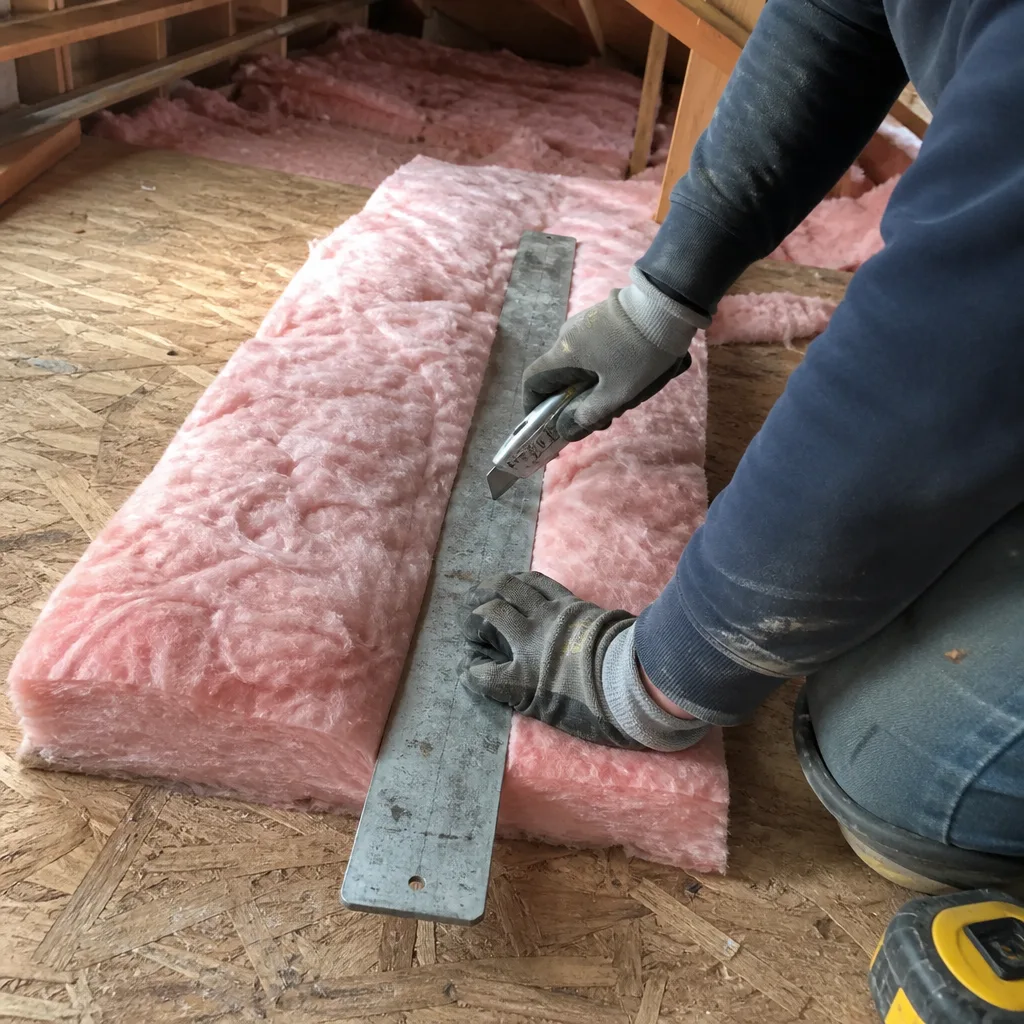
Old insulation removal, if applicable. In most pre-1980 Cupertino homes, the fiberglass batts between the floor joists come out before anything else. Leaving them in under an encapsulated crawl creates a moisture trap – the batts wick condensation and provide ideal nesting material for rodents. Removal is bagged and hauled off-site; Santa Clara County requires documented disposal at an approved facility.
Rim joist air sealing with spray foam. The rim joist – the band of framing that sits on top of the foundation wall and supports the floor system – is one of the highest-loss air sealing locations in a Cupertino home. Two-component closed-cell spray foam is applied to the rim joist before the liner goes in. This is also where before-and-after blower-door readings matter: the air sealing at the rim joist and crawl penetrations is a meaningful contributor to the home’s overall air tightness, and the blower-door number after the job shows the change. We publish those numbers on applicable jobs – not a qualitative description, a specific CFM50 reading.
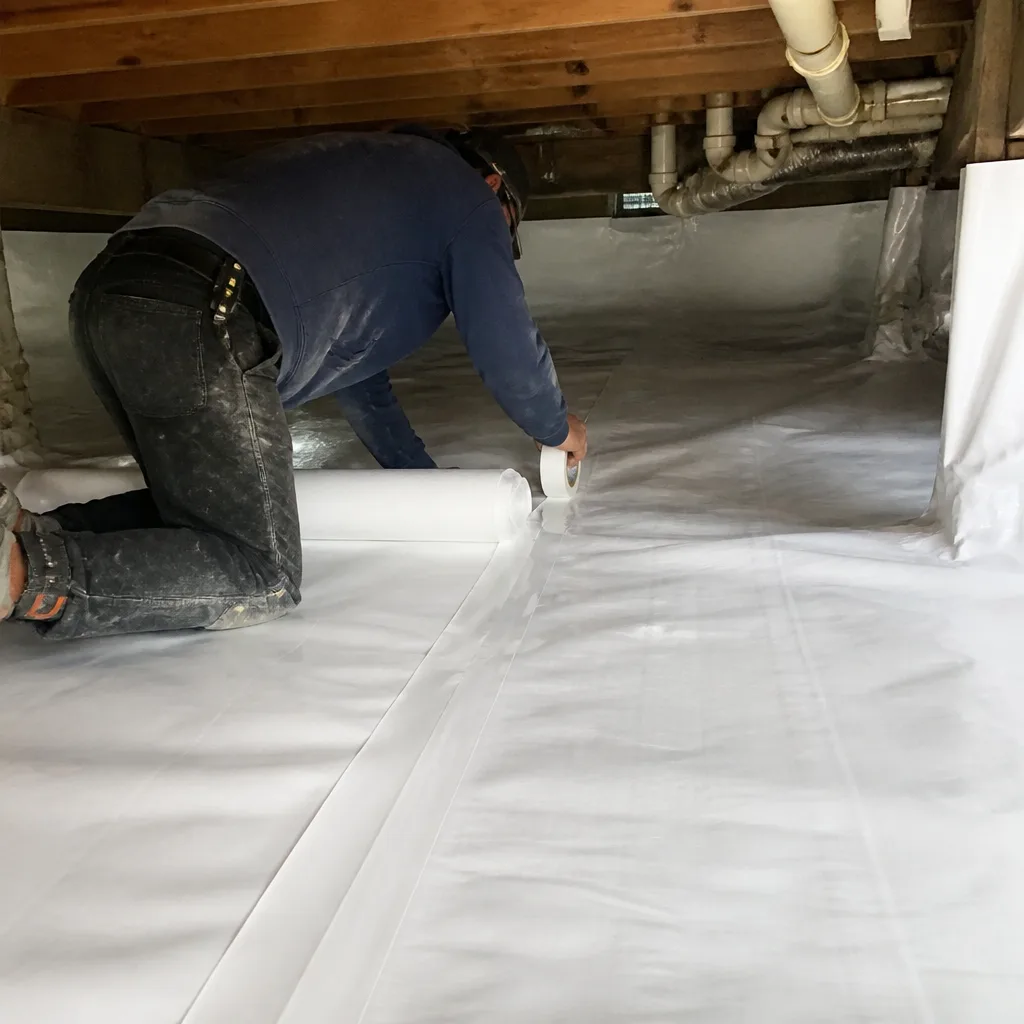
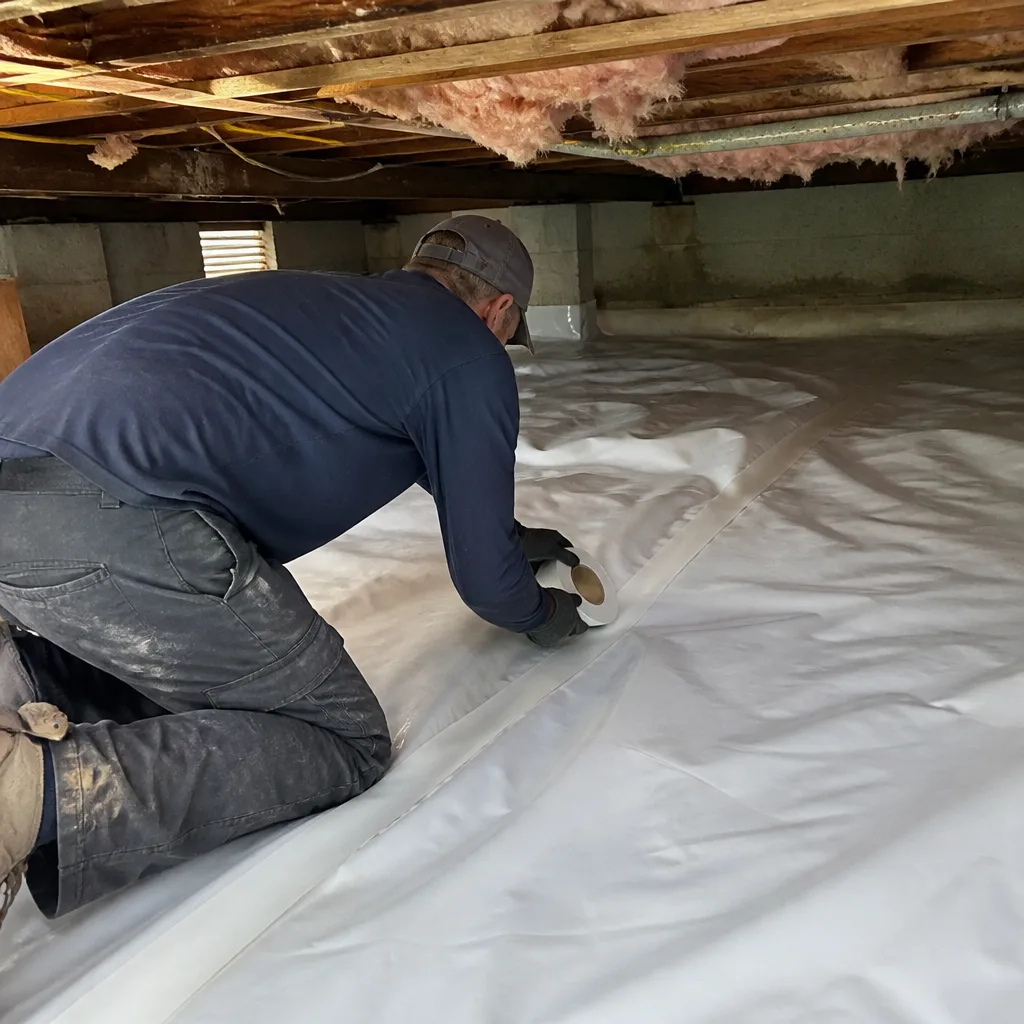
Liner installation. The 20-mil reinforced liner goes down across the ground and is lapped up the foundation walls. Seams are overlapped a minimum of 12 inches and taped with a compatible adhesive tape – not stapled, not left overlapping without adhesion. Mechanical fasteners secure the liner to the foundation wall at the top edge. Every pipe and column penetration gets a fitted boot or hand-cut wrap taped tight.
Vent sealing. Foundation vents are sealed from the interior with rigid foam and spray foam at the perimeter. In a conditioned crawl conversion, these vents are permanently closed. The permit question noted above in the Santa Clara County section applies here.
Final photo record and written documentation. Every completed encapsulation job closes with a photo record of the finished liner, sealed vents, rim joist treatment, and any penetrations. The written warranty and scope are delivered at job completion. The 365-Day Done Right Promise is in writing – if anything about the installation isn’t right, we come back.
Vapor Barrier vs. Full Encapsulation: Which One Does a Cupertino Home Actually Need?
This question comes up on nearly every initial call. The short answer: a vapor barrier is one component of encapsulation, not a synonym for it.
A vapor barrier is the liner itself – a sheet of poly material laid across the crawl floor to block ground moisture from evaporating into the crawl space air. It’s a passive system. A basic vapor barrier installation without sealed vents, sealed rim joists, or wall coverage is appropriate when the crawl is dry, well-ventilated by intention (not by accident), and has no history of moisture intrusion. In Cupertino, this describes relatively few older homes.
Full encapsulation converts the crawl to a semi-conditioned or conditioned space by sealing all moisture entry points – ground, walls, and vents – and managing interior humidity actively. It’s the correct scope when the crawl has seasonal moisture, existing mold or efflorescence, or when the homeowner is adding spray foam at the rim joist as part of an air sealing project.
On our Crawl Space Encapsulation & Vapor Barrier in Cupertino service page, we break down the technical differences and what each approach delivers in terms of moisture management and energy performance. For most Cupertino homeowners, especially those in older neighborhoods like Monta Vista, Garden Gate, and Fairgrove, full encapsulation is the appropriate scope – not because it costs more, but because a partial solution on a home with clay soil and a vented crawl tends to fail within a few years.
If you’re not sure which scope your crawl needs, the assessment visit resolves it. We don’t quote full encapsulation on a crawl that doesn’t need it.
FAQs – Crawl Space Encapsulation & Vapor Barrier Cost in Cupertino
How much does crawl space encapsulation cost in Cupertino, CA?
Full crawl space encapsulation in Cupertino runs $4,500 to $9,500 for most single-family homes, with the majority of projects landing between $5,800 and $7,500 when the scope includes liner installation, vent sealing, rim joist spray foam, and removal of old fiberglass insulation. Vapor barrier-only (liner without sealed vents or wall coverage) starts at $1,800 to $3,200 for a 1,000 to 1,500 square foot crawl. The spread is wide because crawl space conditions vary significantly in Cupertino’s older housing stock. Call (831) 217-8521 for a written estimate – we’ll give you a specific number after the assessment, not a range with an asterisk.
Is full encapsulation worth the cost compared to a basic vapor barrier?
For most Cupertino homes built before 1985, yes – and the reason is specific to local soil and construction conditions. A basic vapor barrier on a vented crawl slows ground moisture but doesn’t stop the humid air entering through foundation vents, which is often the larger moisture source. On a clay-soil lot in west Cupertino, a vapor barrier alone typically degrades within three to five years under persistent moisture pressure, while a full encapsulation system with sealed vents and active dehumidification holds performance for 15 to 25 years with minimal maintenance. The upfront cost difference is $2,000 to $4,000; the service interval difference is measured in decades.
Does crawl space encapsulation require a permit in Cupertino?
Vapor barrier replacement and standard encapsulation (liner, vent sealing, rim joist spray foam) generally do not require a building permit in Santa Clara County as of 2026. Projects that include active conditioning of the crawl space – adding a supply register tied to the HVAC system or a hardwired dehumidifier on a dedicated circuit – may require a mechanical or electrical permit. We confirm permit requirements before the written scope is finalized, and permit costs are included in the price we give you before work starts. We don’t discover permit fees after the job begins.
How long does crawl space encapsulation take in Cupertino?
Most full encapsulation jobs on a standard Cupertino home (1,200 to 1,800 square feet of crawl space) take one to two days. A liner-only install on a clean, accessible crawl can finish in four to six hours. Projects that include insulation removal, mold surface treatment, or drainage matting add half a day to a full day. Low-clearance crawls under 24 inches add labor time regardless of scope. We give a project duration estimate in the written scope so you know when to expect the crew and when the space will be accessible again.
Can I install a vapor barrier myself to save money?
A homeowner can install a basic vapor barrier – laying 6-mil poly sheeting across a flat, dry crawl floor. The savings are real: materials run $0.15 to $0.30 per square foot, versus $1.50 to $3.50 per square foot installed by a contractor. The limitations are also real: a DIY liner typically doesn’t include taped seams, sealed penetrations, or wall coverage, which reduces its effectiveness significantly on any crawl with active moisture. More importantly, a DIY liner doesn’t address the air sealing at the rim joist or foundation vents that drives most of the moisture and energy-loss problem in Cupertino’s older homes. If the goal is managing a minor ground moisture issue in a dry, low-humidity crawl, DIY is defensible. If the goal is solving a moisture or air quality problem, a partial liner without the sealed envelope around it usually doesn’t hold up. We’re straightforward about this when homeowners ask, because a call-back on a job that didn’t work is worse for everyone than a clear scope conversation upfront.
Why Cupertino Homeowners Use Envelope Insulation Co. for Crawl Space Work
Wes Okafor and the team at Envelope Insulation Co. have been doing this work across Cupertino and the broader South Bay since 2016 – more than 9,000 homes sealed and insulated, every one with a written price before work started and a photo record when the crew left. That’s not a marketing claim; it’s the Haven Standard, and it applies to every job regardless of size.
The thing that separates us from most crawl space contractors in the Cupertino market isn’t the liner brand or the dehumidifier model. It’s the documentation. When Wes Okafor signs off on a job, you have a written scope that describes what was installed, a photo record showing the completed work, and a 365-Day Done Right Promise in writing. If a seam lifts, if a vent seal fails, if anything about the installation isn’t right within that first year, we come back.
We’re also the only contractor in this market that treats rim joist air sealing as a standard component of crawl encapsulation work, not an add-on. The reason is straightforward: a sealed liner on the ground with open rim joists and unaddressed penetrations is an incomplete envelope. The blower-door test – a pressurization reading that shows, in one number, how much air the building envelope is losing – demonstrates the difference. We publish those before-and-after numbers on applicable jobs. If a contractor isn’t measuring the result, they can’t tell you whether the work performed.
You can read more about how we approach the full scope of this work on the home page, where we explain the Haven Standard and what the building envelope service line covers from attic to crawl space.
Materials come from manufacturers including Owens Corning, Johns Manville, Rockwool, and Icynene – we’re not locked into a proprietary product line, which means the material specified for your crawl is the right material for your crawl, not whatever a manufacturer relationship requires.
If you have a written estimate from another contractor, bring it. We’ll read it with you – the liner thickness, the vent count, the rim joist treatment, the warranty terms – and tell you exactly what’s there and what isn’t. That’s the Free Second Opinion under the Haven Standard, and it costs you nothing.
Key Takeaways
- Full crawl space encapsulation in Cupertino costs $4,500 to $9,500; most jobs land between $5,800 and $7,500.
- Vapor barrier-only installations start at $1,800 to $3,200 but are appropriate only for dry, low-moisture crawl conditions.
- Cupertino’s clay soils, older housing stock, and proximity to open space corridors make moisture and pest management a more complex scope than national pricing guides reflect.
- Rim joist spray foam, vent sealing, and old insulation removal are typically part of the correct scope for a pre-1985 Cupertino home – not optional upsells.
- Santa Clara County does not require a permit for most standard encapsulation projects as of 2026; active conditioning may trigger a mechanical permit.
- Every Envelope Insulation Co. project starts with a written price and ends with a Documented Photo Record – no exceptions.
- The 365-Day Done Right Promise is in writing on every completed job.
- California’s 25C federal tax credit may apply to qualifying insulation and air sealing work – confirm eligibility with a tax professional.
Pricing reflects the Cupertino market as of 2026. Topside Attic Insulation Cupertino offers free estimates – call (831) 217-8521.
Written by Wes Okafor, Owner at Envelope Insulation Co., serving Cupertino since 2016.
What Our Customers Say
"They photographed rodent damage in the old insulation that we had no idea about, and priced the exclusion work separately so we could decide."
- Harriet N."Two other companies quoted to blow more insulation on top of what was there. These were the only ones who said the existing material had to come out first, and explained why."
- Clifford E."Crawl space encapsulation done properly. Photographs of the vapour barrier at every seam, and the damp smell in the hallway is gone."
- Ainsley P.